



MUST READ!!! How To Identify Fake Products In Nigeria And Verify Them With NAFDAC
A customer walks into a pharmacy, asks for a familiar medicine, and spots the National Agency for Food and Drug Administration and Control (NAFDAC) registration number printed neatly across the package.
The box looks original. The colors are crisp. The manufacturer’s logo is in place, and the price is attractive. The customer pays and walks away.
For millions of Nigerians, that is where the authenticity check ends. It shouldn’t.
A NAFDAC number printed on packaging is merely a printed claim. The critical question is whether that claim matches the verified regulatory records held in NAFDAC’s central database.
With sophisticated syndicates exploiting open markets, modern logistics hubs, and social media storefronts to move adulterated consumables, learning how to digitally audit what you buy is an essential life skill.
Quick Reference: Official NAFDAC Verification Tools
| Verification Channel | Target Category | Access Method | What You Need |
|---|---|---|---|
| Mobile Authentication Service (MAS) | Antimalarials, Antibiotics, High-Risk Rx | Free SMS to 38353, 38351, or 20831 | 10–12 digit scratch-panel PIN |
| NAFDAC Greenbook | Registered Human Pharmaceuticals | Web: greenbook.nafdac.gov.ng | Product Name, Active API, or NRN |
| NAPAMS Portal | Foods, Water, Cosmetics, Agrochemicals | Web: registration.nafdac.gov.ng | NAFDAC Registration Number (NRN) |
Why Fake Products Are No Longer Just ‘Fake Drugs’
When most people hear “counterfeit goods,” they picture fake malaria tablets or lifestyle pills. But NAFDAC’s regulatory remit covers:
- Packaged foods, drinks, and infant formulas
- Prescription and over-the-counter pharmaceuticals
- Cosmetics, toiletries, and skincare items
- Herbal preparations and nutraceuticals
- Medical devices, diagnostic strips, and sanitary products
- Packaged water, veterinary medications, and agrochemicals
Counterfeiters target anything with commercial velocity. In recent enforcement alerts on counterfeits, NAFDAC highlighted this broad scope:
- Critical Biologics: Counterfeit vials of oncology drugs such as Avastin (400mg/16ml) and Tecentriq (1200mg/20ml) distributed at steep discounts.
- Reproductive Healthcare: Falsified batches of Postinor-2 disowned by authorized marketing authorization holders.
- Packaged Foods & Dairy: Counterfeit Cowbell “Our Milk” sachets circulating long after official production transitioned to “Our Creamy Goodness,” alongside unapproved repacking of commercial rice brands like Big Bull.
The Regulatory Vocabulary: Falsified vs. Substandard vs. Unregistered
Understanding official health warnings requires distinguishing between key terms:
- Counterfeit / Falsified: A product deliberately and fraudulently mislabeled regarding its identity, composition, or source.
- Substandard: An authorized product produced by a licensed manufacturer that fails to meet required chemical, potency, or safety benchmarks.
- Unregistered: A product that has bypassed mandatory NAFDAC evaluation, laboratory analysis, and market authorization entirely.
- Adulterated: A product degraded or contaminated by substituting cheaper ingredients, industrial fillers, or hazardous dyes (such as Sudan IV in palm oil).
Crucial Rule: Social media buzz does not constitute scientific evidence. Suspected products must undergo certified laboratory evaluation by regulatory authorities before public safety determinations can be made.
Can a Counterfeit Product Carry a Genuine NAFDAC Number?
Yes. Modern illicit packaging plants use high-resolution offset printing and cloned holographic foils. A syndicate can simply copy a valid NAFDAC registration number from an authentic product and print it across millions of fraudulent packs.
Seeing a registration code on a label proves only that the printer knew how to type it. You must cross-reference that number with NAFDAC’s official registries.
3 Official Ways to Verify a Product Before Use
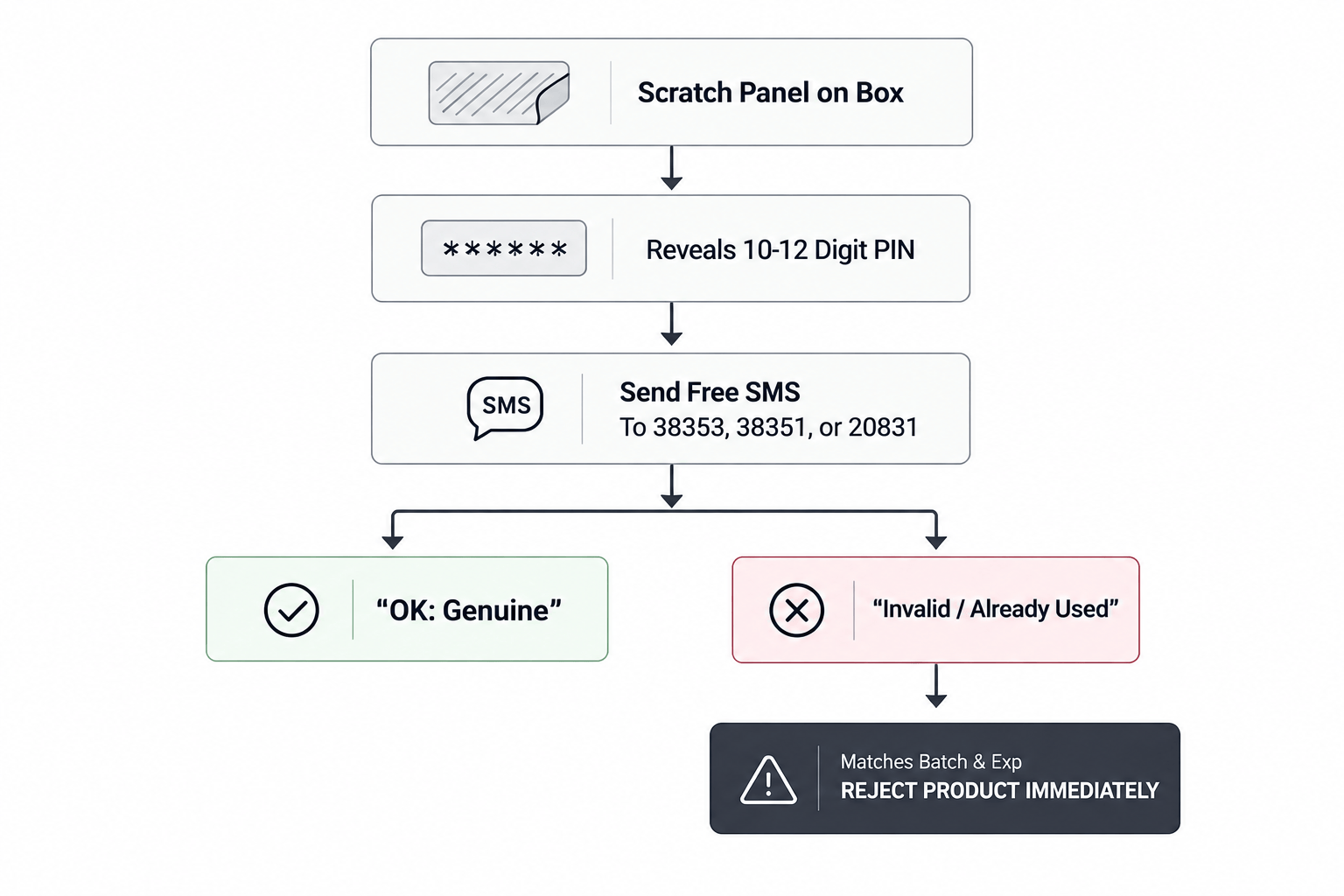
1. Use the Mobile Authentication Service (MAS) for Prescription Drugs
The MAS system remains the fastest way to confirm frontline pharmaceuticals at the counter:
- Locate the Scratch Panel: Check the blister pack or outer carton for a silver security scratch strip.
- Reveal the PIN: Gently scratch off the coating to expose a unique 10- to 12-digit PIN.
- Send the SMS: Text the PIN to the designated toll-free shortcode on the pack (typically 38353, 38351, or 20831).
- Evaluate the Reply: You will receive an instant automated message confirming the product name, batch number, and expiry date. If the message reads “Invalid PIN” or “Already Used,” do not purchase the product.
2. Search the NAFDAC Greenbook Database
The Greenbook is NAFDAC’s public portal for authorized human medications:
- Navigate directly to
NAFDAC Greenbook website. - Enter the NAFDAC Registration Number (NRN), Product Name, or Active Ingredient.
- Select “Search” and review the results.
- Compare the Core Data: Check that the registered manufacturer, dosage strength, route of administration, and physical formulation match the physical box in your hands. If the number exists but belongs to a completely different company or drug, it is a cloned fake.
3. Verify via the NAPAMS Portal (Food, Water & Cosmetics)
For non-drug consumables, NAFDAC maintains the Automated Product Administration and Monitoring System (NAPAMS):
- Visit the NAPAMS verification portal.
- Select the “Verify Your Product” module.
- Choose the appropriate product category (e.g., Food, Water, Veterinary, or General Regulated Goods).
- Type in the registration code printed on the item.
- Confirm that the approval status is active and that the registered applicant corresponds with the product label.
Physical Red Flags: What to Check at the Counter
Combine digital verification with an on-the-spot physical audit:
- Unrealistic Price Cuts: If a vendor offers an imported medication, premium spirit, or high-demand food staple at 30% to 50% below standard market rates, proceed with caution.
- Tampered Tamper-Evident Seals: Look for torn neck shrink-sleeves on bottles, re-glued carton tabs, or missing blister foil backing.
- Misspellings and Phonetic Imitations: Check every letter of the brand name. Counterfeiters often deploy lookalike variations (e.g., “Coglaet” for Colgate).
- Mismatched Batch Coding: Verify that the manufacturing date, expiry date, and lot number on the outer paper carton match the numbers stamped on the internal blister or bottle.
What to Do If You Spot or Purchase a Fake
If a product fails digital verification or exhibits clear markers of fraud:
- Retain the Physical Evidence: Keep the container, remaining contents, and outer packaging. Do not throw them away.
- Secure the Transaction Paper Trail: Keep your receipt, cash transfer slip, seller’s web link, or social media chat history.
- Stop Use Immediately: Do not finish the course or pass the item to another person.
- Lodge an Official Report: File a direct complaint using the substandard and falsified reporting form on the NAFDAC Greenbook site, or email
reforms@nafdac.gov.ngandpharmacovigilance@nafdac.gov..ng
A printed NAFDAC number is an unverified claim until you test it against the official database. Spending 30 seconds verifying a product before you pay is the most reliable defense for your family’s health and safety.
Frequently Asked Questions (FAQ)
How do I check if a product is genuine in Nigeria?
Check the package for a Mobile Authentication Service (MAS) scratch panel and text the revealed PIN to the printed shortcode (such as 38353). For foods, cosmetics, and drugs without an SMS panel, search the printed NAFDAC Registration Number on the official NAFDAC Greenbook or the NAPAMS verification portal.
What is the NAFDAC Greenbook?
The NAFDAC Greenbook is the agency’s official online database of all approved and registered pharmaceutical products. It allows the public to cross-reference drug names, active ingredients, dosage forms, and manufacturer records with physical packaging.
Why does a fake product have a real NAFDAC number?
Counterfeit syndicates regularly clone legitimate NAFDAC numbers from genuine items and print them onto unauthorized packaging. A printed number only proves authenticity if the online database record matches the product’s exact name, manufacturer, and strength.
What should I do if a NAFDAC number brings up no results?
First, check for typos, spaces, or missing hyphens. If the number still yields no results, do not consume or apply the item. Ask the vendor for clarification, pause the purchase, and report the product to NAFDAC’s pharmacovigilance team.


